3 min read
Konbini Japanese: the words you need at the corner shop
Japan's convenience stores are where many travellers speak their first real Japanese. The everyday phrases, and how Kanjira's Konbini game lets you practise them.
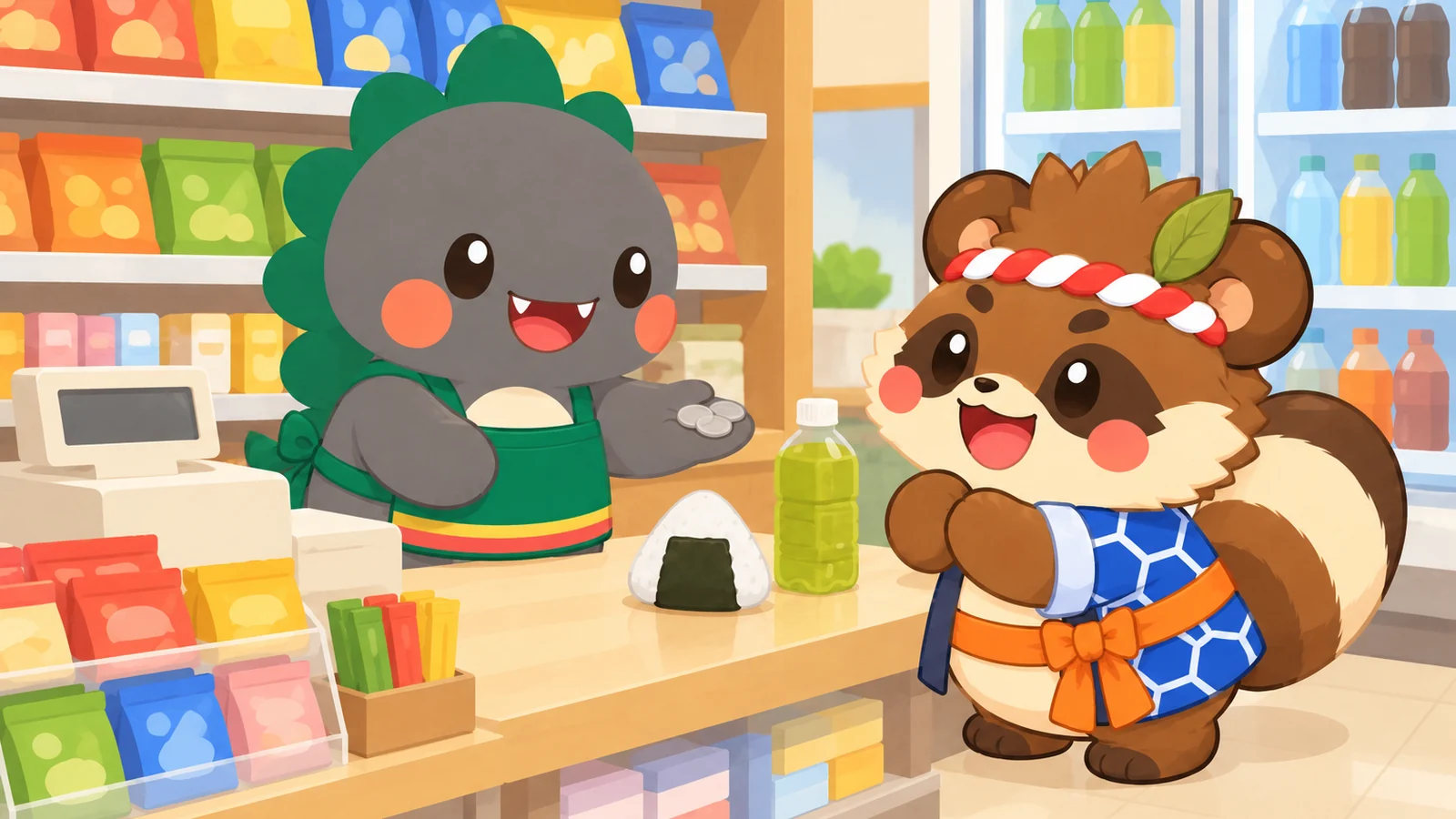
Sooner or later, everyone in Japan ends up in a konbini, the small convenience store on almost every corner. It's where you grab breakfast, a drink for the train or a snack at midnight. For many learners, it's also where they speak their first real Japanese with a stranger. The good news: konbini Japanese is short, friendly and very predictable.
The phrases you'll hear and say
When you walk in, the staff call out いらっしゃいませ (irasshaimase, welcome). You don't have to answer; a nod is fine. At the till, a handful of words carry you through:
- ください (kudasai, please (give me)). Put it after what you want: おにぎりを ください (onigiri o kudasai, a rice ball, please).
- あたためますか? (atatamemasu ka?, shall I heat it up?) You'll hear this with a bento. Answer はい (hai, yes), or ask first: あたためて ください (atatamete kudasai, please heat it up).
- Numbers and えん (en, yen). The total comes as ぜんぶで … えん です (zenbu de … en desu, that's … yen altogether).
- おつり (otsuri, change), the money you get back.
- ありがとう (arigatō, thank you), always welcome on both sides of the counter.
To ask for more than one, use the counting words ふたつ (futatsu, two) and みっつ (mittsu, three): おにぎりを ふたつ ください (onigiri o futatsu kudasai).
Behind the counter: Kanjira's Konbini
In the app, you see the konbini from the other side. Kanjira runs a little shop of its own, and Kanjira's friends come in to buy things. They order in Japanese, as text, out loud or both. You find the right goods on the shelves, put them in the basket, ring them up and count out the change in yen.
Every item on the shelves is a word from Kanjira's word cards, with its translation and pronunciation, so the shop doubles as a vocabulary lesson. And there's no timer. Customers wait patiently while you look for the のみもの (nomimono, drinks) or the おかし (okashi, sweets).
A shop that grows with you
The konbini starts as a tiny kiosk: one customer, one word, one item. As you earn money, you expand it step by step, and every stage adds a new idea. Customers begin to ask for two things at once with と (to, and). A hot counter arrives, and you have to remember to offer to heat things up. Later, customers want two or three of something, and in the biggest shop they mostly just say what they want.
Between customers there's shop life, too: the weather of the day, like きょうは あめ (kyō wa ame, it's raining today), deliveries to put away and an order list for tomorrow. Even the shop's own words, like うりきれ (urikire, sold out), are words to learn.