3 min read
Writing the 46 hiragana, one stamp at a time
Hiragana are the first Japanese script most learners meet. How Kanjira teaches you to write all 46, why stroke order matters, and what the stamps are for.
Japanese uses three scripts side by side. Kanji carry meaning, katakana mostly spell words from other languages, and hiragana hold everything together: grammar endings, small words, and the readings printed above kanji. If you learn one script first, make it hiragana. There are 46 basic characters, and you can learn to write every one of them in Kanjira for free.
Why stroke order matters
Every character is written in a fixed order of strokes, each in a fixed direction. It can feel like a rule for its own sake, but it pays off quickly:
- Your characters come out balanced. Stroke order keeps the proportions right, so あ looks like あ and not like a knot.
- You read handwriting better. Handwritten kana often join strokes together, and that only makes sense once you know where each one goes.
- Look-alikes stop being confusing. さ (sa) and ち (chi) are mirror images, ぬ (nu) and め (me) differ by a single loop, and ね (ne), れ (re) and わ (wa) start the same way. Writing them by hand makes the difference stick.
Kanjira's stroke data comes from KanjiVG, an open project that records the order and direction of every stroke.
Watch, trace, then from memory
Writing in Kanjira takes three steps for each character:
- Watch. The character draws itself, stroke by stroke, so you see the order and the direction.
- Trace. You follow each stroke with your finger, starting at the dot. If a stroke starts in the wrong place or runs the wrong way, Kanjira asks you to try again.
- From memory. The guide disappears, and you write the character on your own.
Get through all three and the character earns its stamp. Your finger movements are only used while you draw, to check the strokes: the app keeps your progress, never the drawing itself.
The stamp book
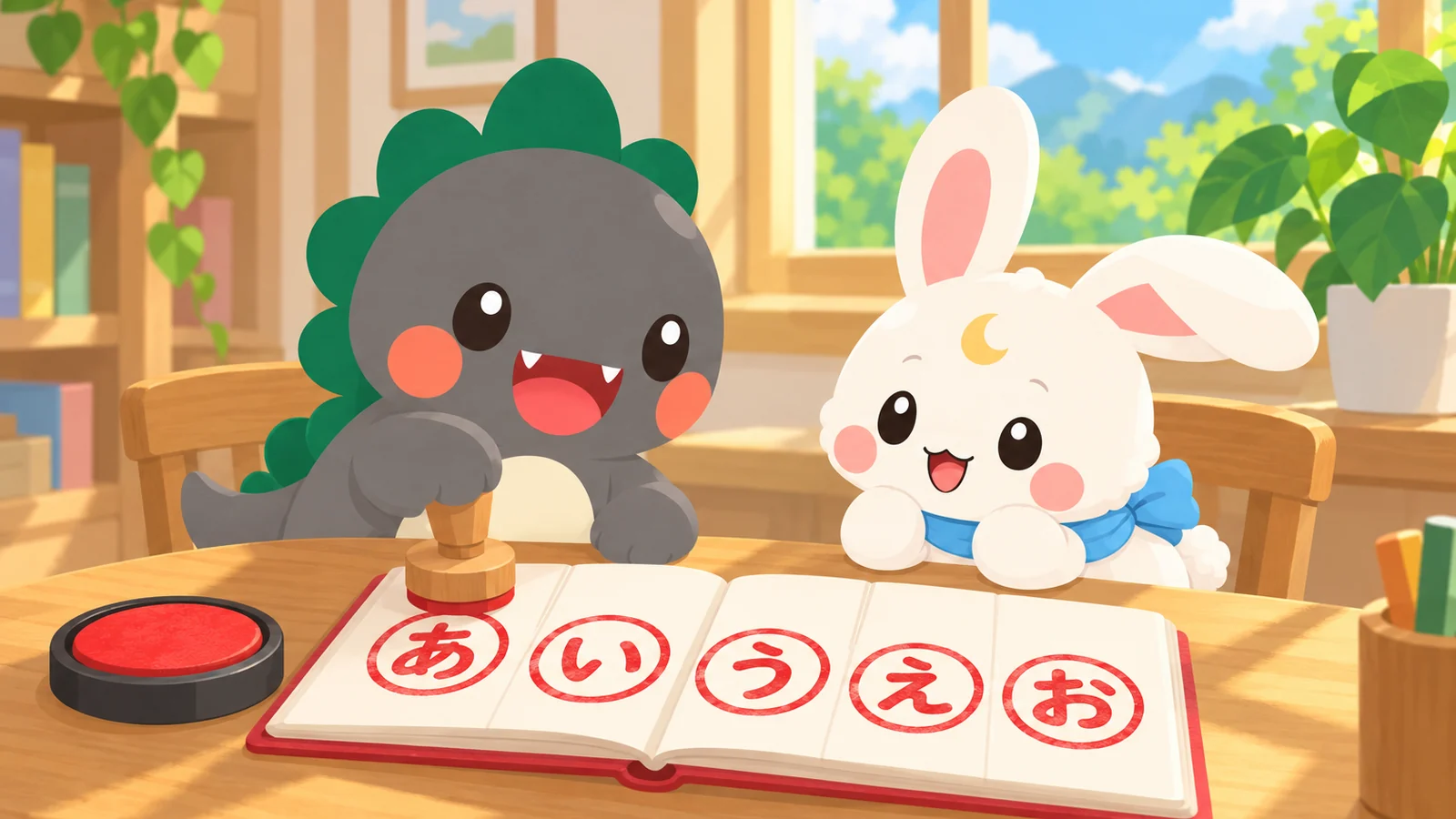
Every finished character lands in your stamp book, so you can watch the page fill up. It's a small thing, but it turns practice into collecting. Some days you stamp a whole row, some days a single tricky character like を (wo). Both count.
The rows follow the classic order of the Japanese syllabary: あいうえお, then かきくけこ, and on through the table to ん (n). Learning row by row means every new row reuses vowels you already know.
After hiragana
Once the 46 hiragana feel familiar, katakana writing and Listen & write come with Kanjira Pro. In Listen & write you hear a word and write it down, which ties sound and shape together. There's no rush, though. Hiragana alone already let you read the small furigana over kanji, and that opens up a lot of Japanese.